SurgTPGS++: Text-Promptable Gaussian Splatting with Dense Features Aggregation for Semantic 4D Surgical Scene Understanding
A unified Gaussian Splatting framework for dynamic 4D reconstruction, real-time language-assisted 3D querying, and semantic segmentation in surgical scenes.
Extended work of SurgTPGS, MICCAI 2025
Abstract
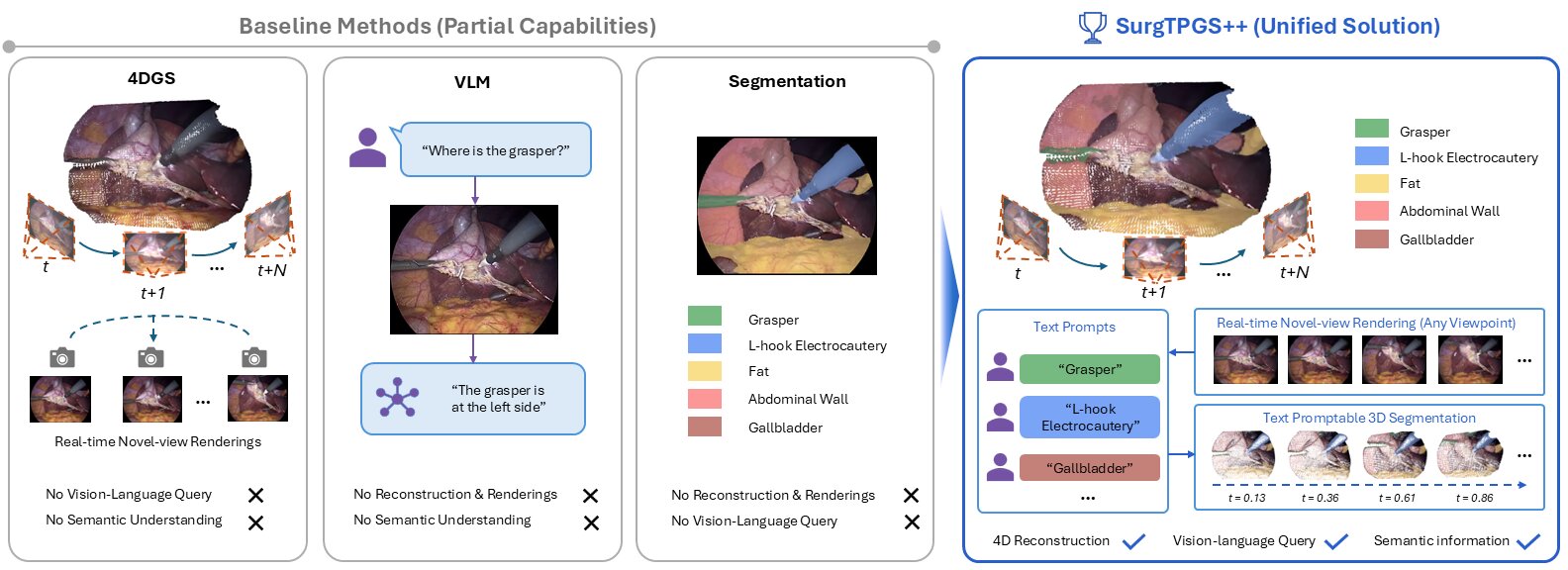
With the growing demand for surgical embodied intelligence, accurate semantic understanding of 3D surgical scenes with language-based interaction has become increasingly important. Such capability can assist surgeons in identifying and interacting with surgical instruments and anatomical structures during pre-operative planning and real-time intra-operative guidance. However, existing methods typically address surgical vision-language modeling, 3D reconstruction, and semantic segmentation as separate tasks, leaving real-time language-assisted 3D querying in dynamic surgical scenes largely unexplored.
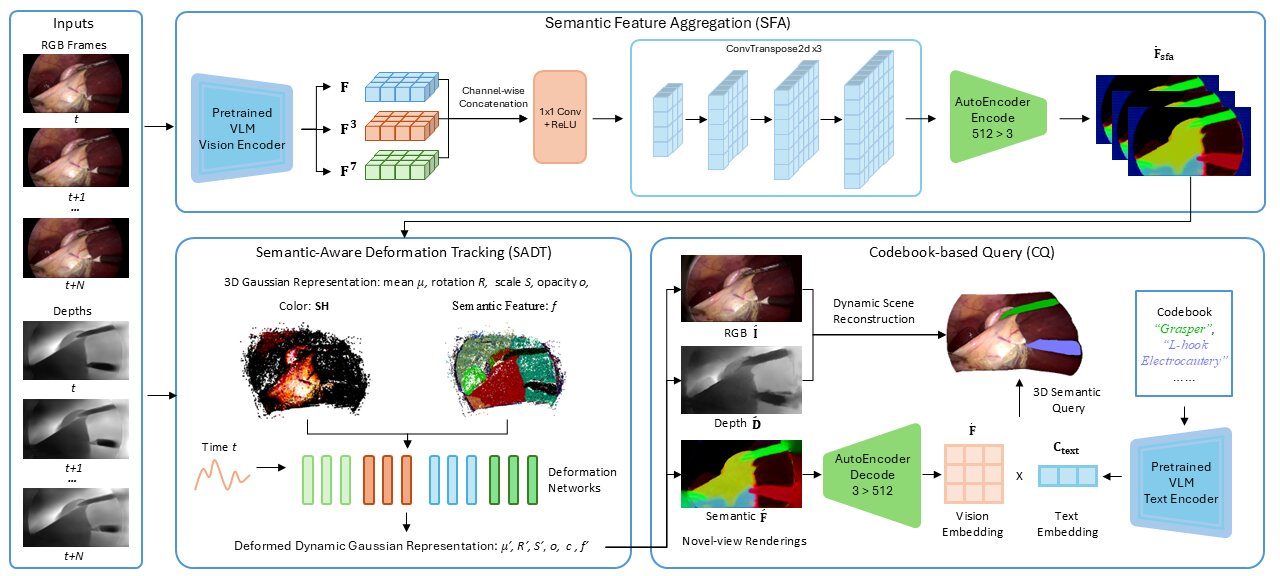
We present SurgTPGS++, a Gaussian Splatting pipeline for text-promptable 3D surgical scene understanding. SurgTPGS++ introduces semantic feature aggregation (SFA) to extract and integrate rich vision-language features from multi-domain VLMs, embeds the aggregated features into semantic-aware 3D Gaussians, and applies semantic-aware deformation tracking (SADT) to model temporal deformation of both texture and semantic features. A codebook-based query (CQ) module then matches rendered semantic features with text-codebook embeddings, enabling real-time language-assisted 3D segmentation from arbitrary viewpoints and timestamps.
Highlights
Unified Surgical 4D Understanding
SurgTPGS++ jointly represents appearance, geometry, dynamics, and language-aligned semantics in one deformable Gaussian scene.
Semantic Feature Aggregation
SFA fuses patch-level CLIP features with intermediate ViT features to produce dense semantic supervision without explicit mask proposals.
Semantic-Aware Deformation
SADT deforms semantic features alongside texture and geometry, preserving temporal consistency under tissue and tool motion.
Codebook-Based Query
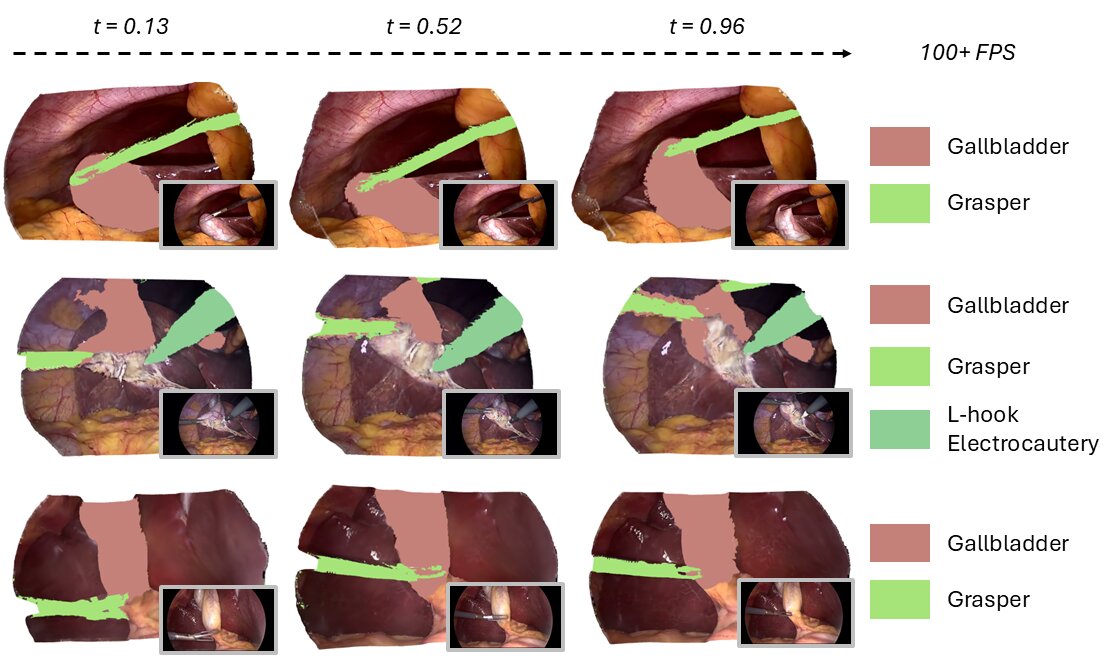
CQ converts multi-text prompting into a stable in-codebook assignment, enabling efficient real-time 3D segmentation.
Dynamic Text-Promptable Segmentation
Pipeline
Extended From SurgTPGS
Dense feature aggregation. The extended work reduces reliance on SAM-based region proposals and simple VLM finetuning by aggregating multi-level VLM features into dense language-aligned maps.
Dynamic semantic tracking. Semantic features are embedded into the Gaussian representation and tracked through deformation, improving 4D consistency for surgical tools and deformable anatomy.
Efficient multi-text querying. CQ performs a single codebook matching operation instead of repeated prompt-wise querying, increasing query speed from 67.5 FPS to 246.64 FPS.
Results
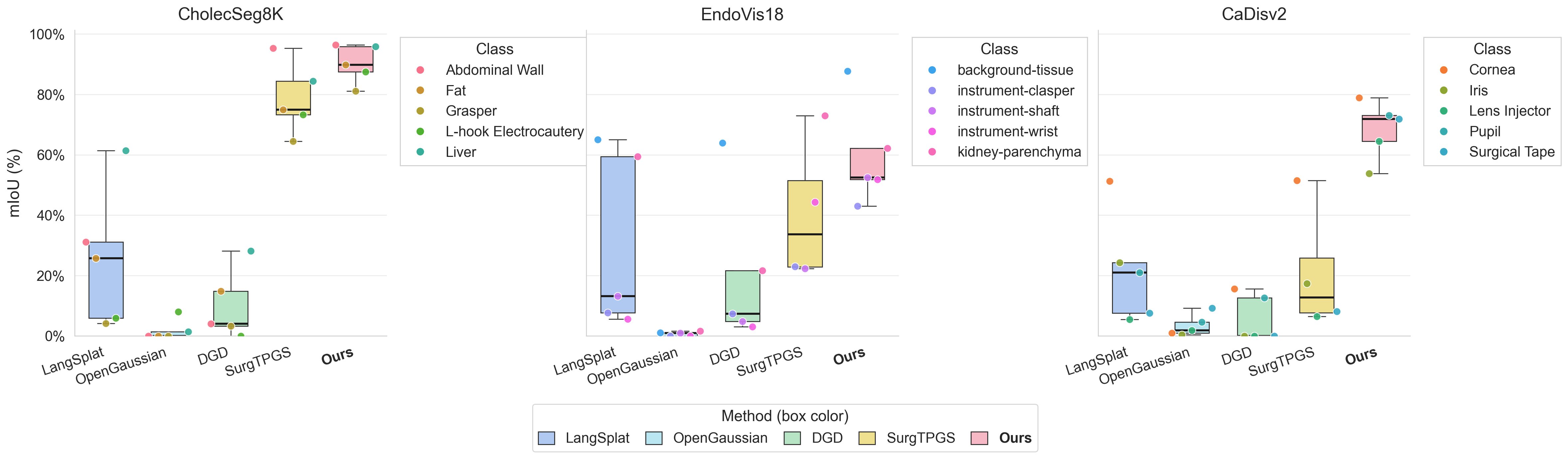
Quantitative Comparison
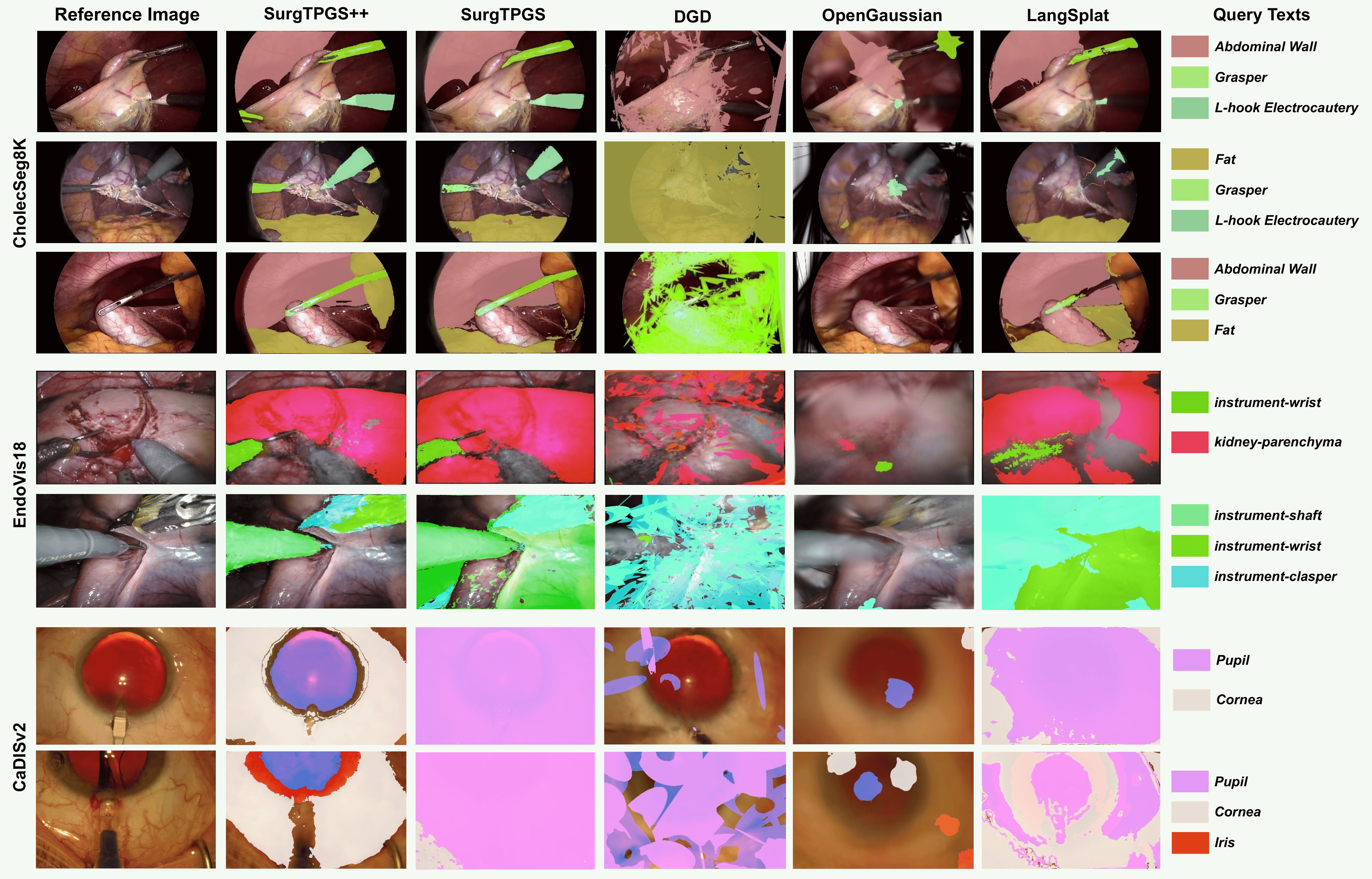
Qualitative Comparison
BibTeX
@article{huang2026surgtpgs++,
        title={SurgTPGS++: Text-promptable Gaussian Splatting with dense features aggregation for semantic 4D surgical scene understanding},
        author={Huang, Yiming and Bai, Long and Cui, Beilei and Yuan, Kun and Wang, Guankun and Hoque, Mobarak I and Padoy, Nicolas and Navab, Nassir and Ren, Hongliang},
        journal={Medical Image Analysis},
        pages={104318},
        year={2026},
        publisher={Elsevier}
      }